

Yes, it's real. The Zimbabwe $100 trillion dollar note
What the highest-denomination banknote ever printed is, how to tell a genuine one from a copy, and what collectors look for.
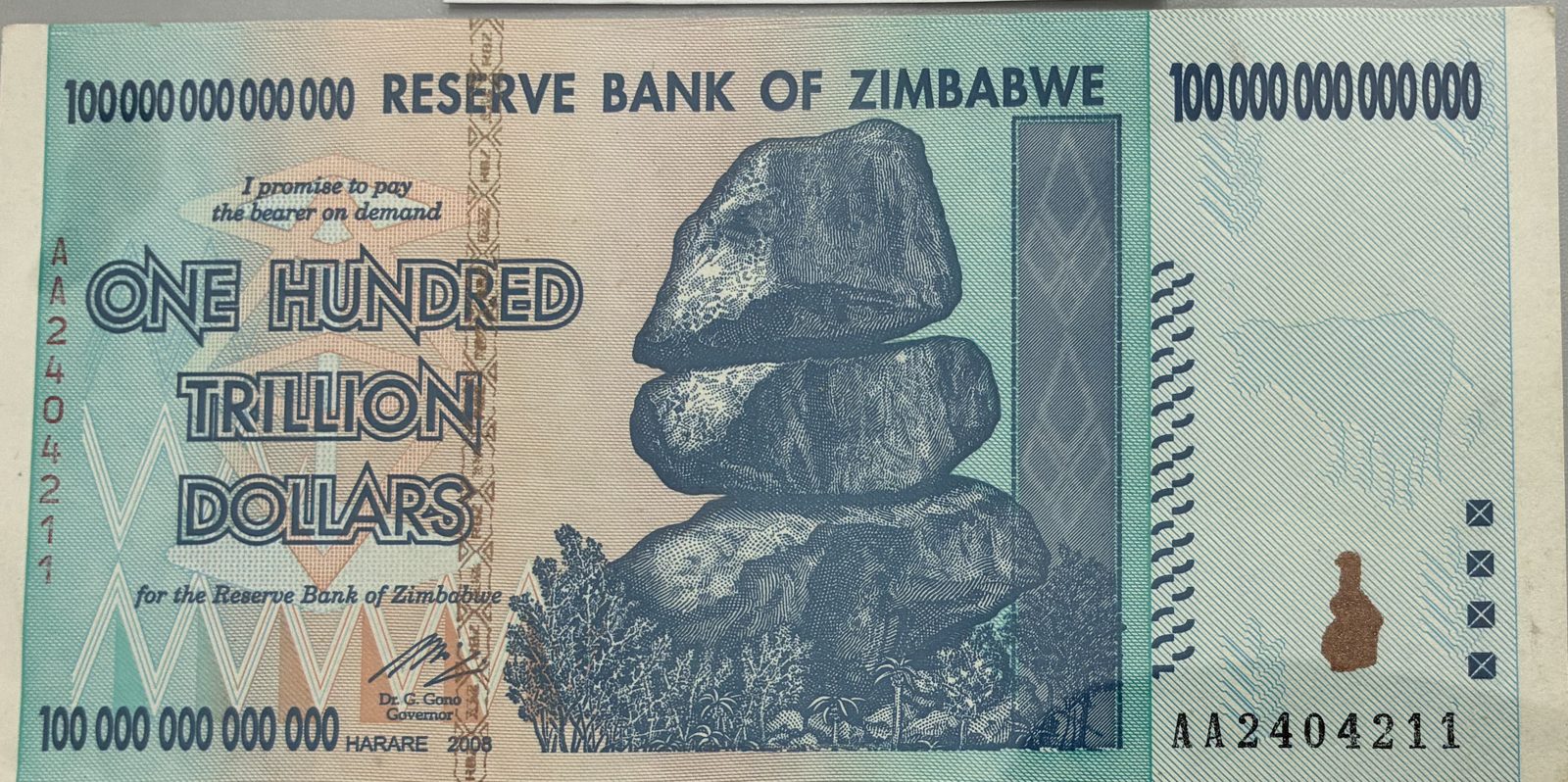
If you've stopped by our counter on Socastee Boulevard, you've probably seen it: a blue and peach banknote in a sleeve with a sign that says YES IT'S REAL! It gets more questions than anything else in the shop, so here are the answers.
What it is
This is a genuine 2008 Reserve Bank of Zimbabwe one hundred trillion dollar note. That's a one followed by fourteen zeros. It is the highest face-value banknote any government has ever put into circulation.
It was released in January 2009 at the very end of Zimbabwe's hyperinflation, when prices were doubling faster than the printers could keep up. Within about three months the country stopped using its own dollar altogether and switched to the U.S. dollar and South African rand. The note was formally demonetized in 2015. It never bought much even when it was new. Today it's a collector's item, and a well-known one.
The front shows the Chiremba balancing rocks near Harare. The back shows Victoria Falls and a Cape buffalo. It's signed by Dr. Gideon Gono, then governor of the Reserve Bank.
The note at a glance
- Issuer
- Reserve Bank of Zimbabwe
- Dated
- 2008 (released Jan 2009)
- Catalog
- Pick 91
- Size
- 148 × 74 mm
- Signature
- Dr. Gideon Gono
- Front
- Chiremba balancing rocks
- Back
- Victoria Falls, Cape buffalo
- Status
- Demonetized 2015
Why we keep one at the counter
We buy and sell gold, silver, and coins. A note like this is the clearest picture we know of what happens to paper money when trust in it runs out, and it's a big part of why so many of our customers like holding something physical. It's also just a remarkable object. People bring their kids in to see it.
How to tell if a Zimbabwe $100 trillion note is genuine
Because these notes are collectible, copies exist. Most are easy to spot once you know what to look for. On a genuine note:
- The serial number is printed in red, in the format of two letters followed by seven digits. AA is by far the most common prefix. AB and AC exist but are scarcer.
- The front is intaglio printed, so the fine lines have a slightly raised feel under your thumb. Flat, glossy printing is a warning sign.
- The Zimbabwe bird near the left edge is printed in color-shifting ink and changes tone as you tilt the note.
- A narrow iridescent stripe runs down the note with "RBZ" repeated along it.
- The note measures 148 by 74 millimeters. Copies are often slightly off.
- Under UV light, the serial numbers glow orange and there are fluorescent fibers scattered in the paper.
Sources disagree on whether the note carries a watermark, so don't rely on that one. If you want a definitive answer, bring it in. We look at paper money the same way we look at coins: in person, under magnification, at no charge.
What is a Zimbabwe $100 trillion note worth?
Quite a bit more than face value, which is zero. The collector market for these notes is active and prices depend on three things: whether the note is genuine, its condition, and its serial prefix. A crisp uncirculated example sells for far more than a folded, handled one, and third-party graded notes (PMG or PCGS Banknote) bring a premium on top of that.
We don't post a number here because it moves and because condition matters so much. If you have one, we'll tell you what you're holding and what it's likely worth in today's market.
Common questions
Is the Zimbabwe 100 trillion dollar bill real money?
It was real, legal currency in Zimbabwe for a short period in 2009. It has not been legal tender since 2015 and cannot be spent or exchanged at a bank. Its value today is as a collectible.
How many Zimbabwe 100 trillion notes were printed?
The Reserve Bank of Zimbabwe never published a final figure. Enough exist that they're easy to find, but the supply is fixed and uncirculated examples get harder to find each year.
Is the Zimbabwe 100 trillion note a good investment?
We're a shop, not advisors, so we won't tell you what to buy. What we can tell you is what one is worth today and what to look for so you don't overpay for a copy.
Can I see the one at Carolina Gold Exchange?
Yes. It's at the counter at 4486 Socastee Blvd in Myrtle Beach during regular hours. Ask and we'll take it out of the sleeve for you.
Not sure what you have?
Coins, bullion, or jewelry. We'll look at it in person, tell you what it is, and explain how we arrived at the number. Carolina Gold Exchange, 4486 Socastee Blvd, Myrtle Beach, SC 29588. (843) 691-0179.
Related reading
- Coin shop vs pawn shop
How dealers price by real market value, and how to compare offers.
- Rare coins
What we look for in collectible coins and how they're evaluated.
- Sell gold in Myrtle Beach
Testing, weighing, and pricing, explained in front of you.